



Corrugated board – properties, history and why flute direction matters
Corrugated board – key properties
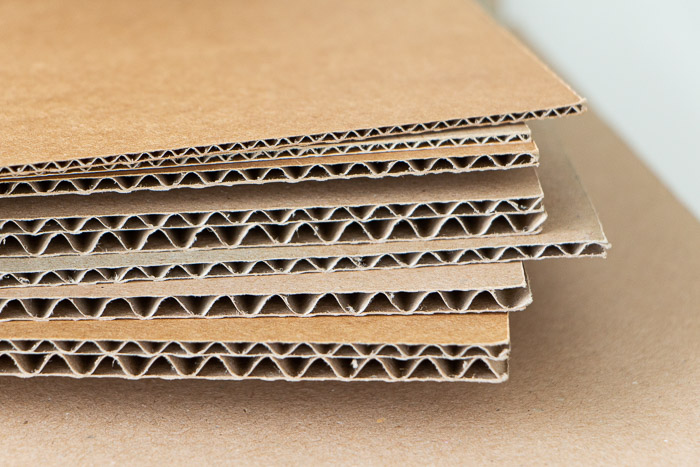
Corrugated board is a material built from two or more layers. The base is usually a brown board made from, among other things, cellulose pulp. At least one layer has a “concertina” structure, so a wavy profile gives the material its resilience. As a result, corrugated board stays relatively light while still offering high strength. In addition, it has become a standard in the wider economy and in trade, especially in packaging.
A short history of corrugated board
The first corrugated board was produced in England in 1856. Two entrepreneurs, Edward G. Healy and Edward E. Allen, ran the process on a fairly simple machine that formed a corrugated paper web. This was possible thanks to two fluted rollers that the sheet passed through. At that time, corrugated material was not yet linked to the packaging industry, because people mainly used it as a filler or stiffener in garments such as hats.
Later, in 1874, the American Olivier Long introduced an important improvement: he started to laminate the corrugated paper with a flat liner. This created a two-layer board. Consequently, the idea significantly accelerated the development of the packaging industry and opened the door for modern corrugated packaging.
How corrugated board is produced
Manufacturers produce corrugated board on a special machine called a corrugator. This line is exceptionally long and can reach up to 150 metres. The process alternates between two paper types: corrugated medium and flat liner. The corrugated layer is formed with corrugating rolls, often referred to as fluting rolls, because they shape the paper and define the flute profile used later in packaging.
Bonding the layers together
To bond the fluted medium to the flat liner, converters use a starch-based adhesive. After this step, the first two layers of corrugated board are in place. Moreover, the sequence can be repeated, so it is possible to build boards with several layers and with very different levels of stiffness and strength. In practice, this flexibility makes corrugated board suitable for both light cartons and heavy-duty transport packaging.
Flute direction – why it matters
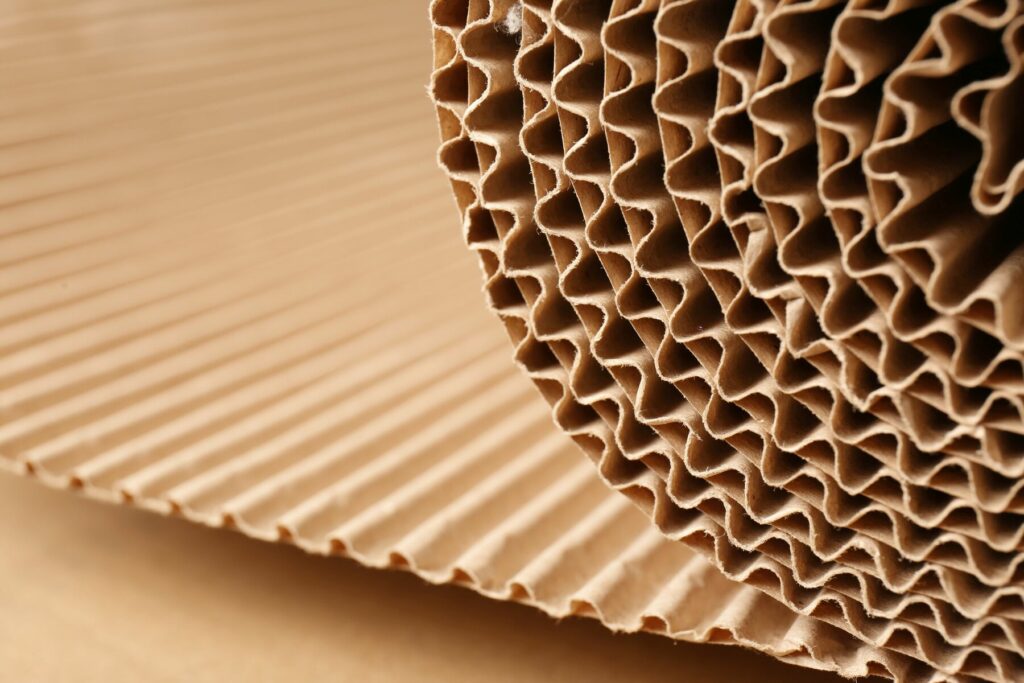
If you look closely at corrugated board, you will see channels that run in one direction and remain parallel to each other. This is the flute. It is important because the flute direction directly influences how a box is folded and how strong it will be. In many projects it is crucial to know which edge the flute runs parallel to before you order material or a cutting die.
Imagine a cutting die, that is, a tool that cuts out a box or a wrap. On the die drawing there are crease lines that define where the board has to bend. These creases have a rounded profile, so they do not cut the board but compress it in a controlled way. Therefore, flute direction and crease direction must work together so that the material folds cleanly instead of breaking or resisting the fold.
If the flute runs parallel to the main creases on the die, folding fine microflute can become difficult. For this reason, when you order corrugated board, it is worth indicating which creases are critical. As a result, the converter can align the flute correctly, avoid production issues and deliver an attractive, well-folding box.
Types of corrugated board and their packaging uses
Corrugated board can have many different constructions, from simple two-layer solutions to advanced structures with up to seven layers. Each type has its own properties and typical applications, defined mainly by strength and printability. Therefore, in the next sections we describe the most common constructions and show where they work best in packaging.
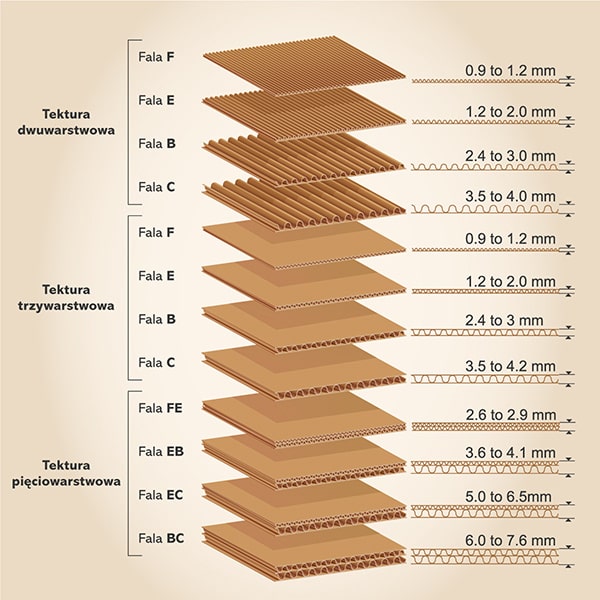
Two-, three- and five-layer corrugated board – flute types and strength indicators
Two-layer corrugated board – the basic option
The simplest corrugated board consists of a flat outer layer (liner) and an inner fluted layer in a concertina shape. The flute gives the material its elasticity and cushioning. In addition, the flat layers provide stiffness, durability and a surface suitable for offset printing, so the board works well in both transport and display applications.
- Flute F: 0.9–1.2 mm; colours: grey/grey, white/white, white/grey
- Flute E (microflute): 1.2–2 mm; colours: grey/grey, white/white, white/grey
- Flute B: 2.4–3 mm; colours: grey/grey, white/white, white/grey
- Flute C: 3.5–4 mm; colours: grey/grey, white/grey
Two-layer corrugated board works well in serial and high-volume production, where cost and quality must be balanced. Moreover, it can be laminated with printed sheets on MMLiner, Kraftliner or GD2 board, therefore you can combine attractive graphics with a lightweight fluted base.
Three-layer corrugated board – the standard in packaging
Three-layer corrugated board has two outer liners and one flute in the middle. It is widely used for litho-laminated boxes, for flexographic printing and for transport cartons. In practice you can print it flexographically over the full surface or with a single spot colour. Furthermore, printed sheets can be enhanced with film, UV varnish, embossing or hot stamping to achieve a more premium look.
- Flute F: 0.9–1.2 mm; 240–300 g/m²
- Flute E (microflute): 1.2–2 mm; 346–490 g/m²
- Flute B: 2.4–3 mm; 277–580 g/m²
- Flute C: 3.5–4 mm; 400–590 g/m²
Five-layer corrugated board – increased resistance
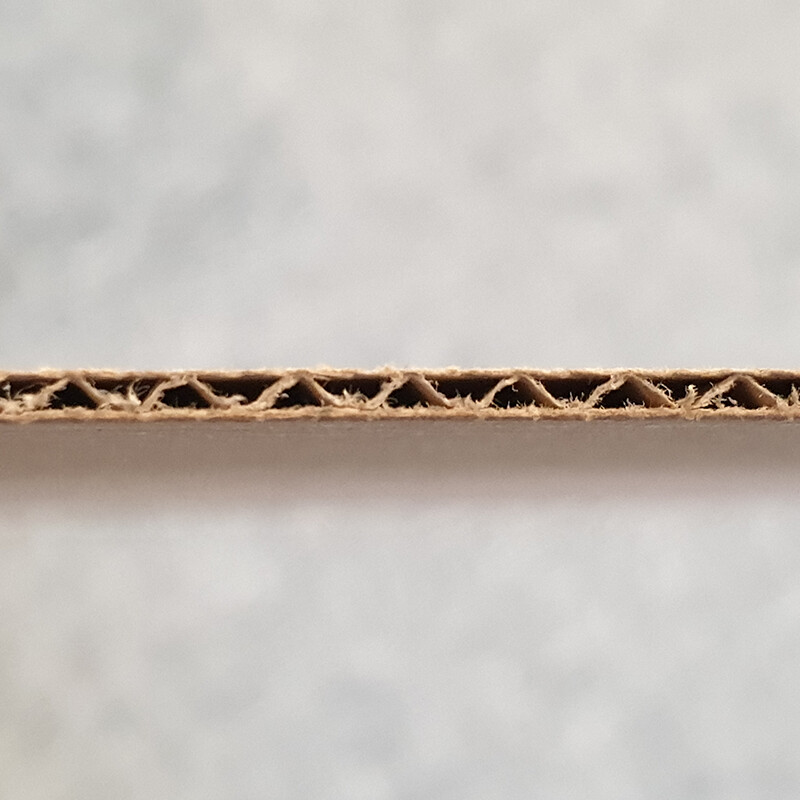
Many industries need materials with higher strength that can still be processed in converting. In these cases, converters use five-layer corrugated board, typically based on EB or BC flute combinations. This structure offers very high resistance to crushing and mechanical damage, therefore it is suitable for heavy or sensitive products.
- EB Flute: height approx. 5 mm, weight 650–850 g/m²

- BC Flute: height 6–7 mm, weight 690–1500 g/m²

Strength indicators: FCT, ECT and BCT
The strength of corrugated board and finished boxes is described with several specialist tests. Most often you will see three key parameters in technical data sheets, therefore it is useful to know what they mean.
- FCT (Flat Crush Test): force needed to crush the flutes when the sheet lies flat.
- ECT (Edge Crush Test): force needed to crush the sheet standing on edge (column crush).
- BCT (Box Compression Test): box resistance to compression between plates until the side walls collapse.
Choosing the right corrugated board is crucial for quality, durability and the look of your packaging. With a suitable flute profile and grammage you can create both elegant gift boxes and robust transport cartons. Write to us – we will help you select the proper flute and board grade for your product.