


Digital printing – why it is becoming more popular
What makes digital printing different?
Digital printing is used more and more often, because it offers several clear benefits. From a technical point of view, it does not require traditional makeready. The file goes directly to the press through a digital connection, so there is no separate plate exposure step. Moreover, the image appears without making a printing plate, without wasting paper on start-up sheets and without time-consuming register settings. As a result, you save time and material, and the total job cost usually drops as well.
Because of this, the technology is especially strong for runs up to a few hundred copies. For small quantities, the cost of plates and makeready in offset can increase the price noticeably. Therefore digital printing often becomes the practical and cost-effective option.
Short runs and personalised jobs
Digital printing is a good choice for low-volume jobs and for projects that require personalisation. In fact, for many personalised applications there is currently no real alternative. Data is sent straight from the RIP or control computer to the press, so you can change names, codes or serial numbers while the job is running. Furthermore, you can update content between batches without stopping for a new plate. In practice, this makes the process flexible, fast and easy to control.
Key advantages of digital printing
- Express production – you do not need to set up plates, so after sending the file you can start almost immediately.
- Small runs – digital printing is very competitive when you only need dozens or a few hundred copies.
- Personalisation – names, codes, numbers or versions can change from sheet to sheet in one print run.
- Attractive cost for short runs – there is no makeready waste and less chemistry, therefore the unit price remains reasonable.
- One-off samples – you can print a single proof copy under production conditions, which classic offset usually cannot offer.
How does digital printing work?
In general, we distinguish four main digital technologies: laser, inkjet, thermal transfer and dye-sublimation printing. In each case the image is created directly from digital data, yet the way the colour reaches the substrate is different. Below we focus on laser printing, because it is one of the most common methods in offices and professional presses.
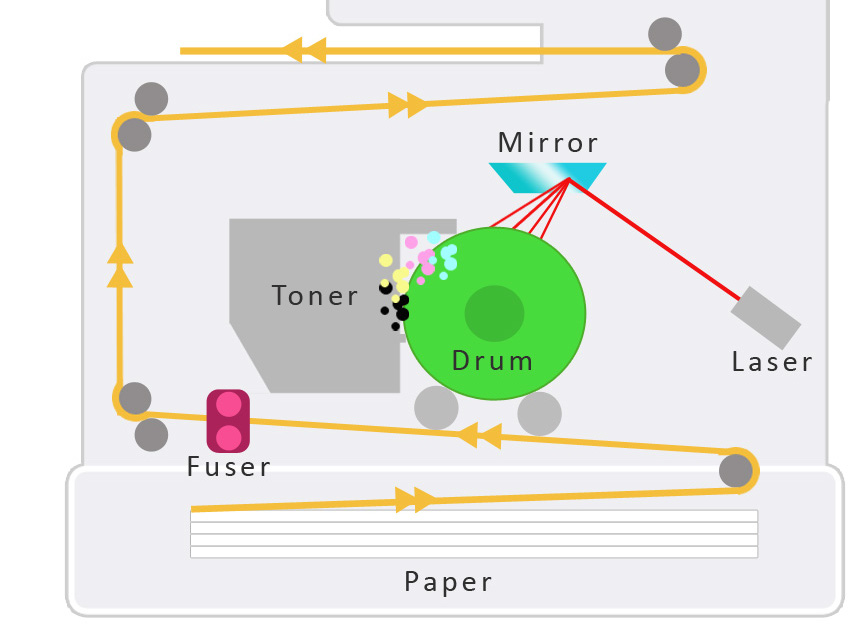
In laser, or electrophotographic, printing the data from the computer is first converted to a signal that controls a laser beam. This beam writes a latent image on a drum that carries an electrostatic charge. Then toner, which is a coloured powder, adheres to the charged areas and transfers onto the paper. Finally, high temperature and pressure fuse the toner with the sheet, so the print becomes durable and ready to use.
Do you need support with choosing a printing method? Get in touch with us, describe your run size and deadline, and we will suggest whether digital or offset printing fits your project better.
Types of Digital Printing: Inkjet, Thermal Transfer and Sublimation
Inkjet Printing (Ink-jet)
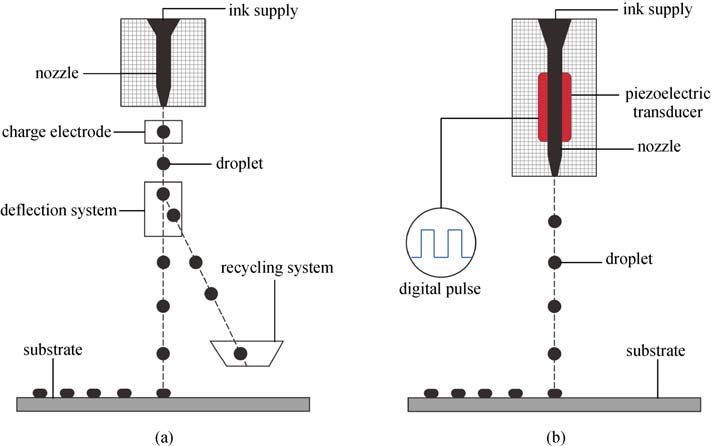
Inkjet printing uses a print head and a pressure pump that sprays tiny drops of ink onto the paper surface. Moreover, the head is controlled by impulses sent from the computer, which makes precise image reproduction possible. In practice, this technology works either with a continuous stream of drops or with single impulses, depending on the system.
Inkjet printing is used in industrial and large-format printing, in many production runs as well as in various thermal sublimation solutions. Therefore it is one of the most versatile digital methods on the market.
Thermal Transfer Printing
In thermal transfer printing, the print is first created on a thermal transfer ribbon. Afterwards, the ribbon is pressed onto the substrate and the image is fixed by high temperature. As a result, the ink moves from the ribbon to the material and forms a durable mark on the surface.
Sublimation Printing
Sublimation printing is based on special sublimation inks. First, the design is printed on a foil or on thermal transfer paper. Then the print is pressed onto the final substrate and exposed to heat. Thanks to this process, the ink penetrates the fibres and colours them permanently, so the print looks as if it were fused with the material surface.
Does Digital Printing Have Disadvantages?
Digital printing also has its limitations. However, compared to the many advantages, the list is relatively short. In addition, part of this information may change as technology develops, so it should be treated as a snapshot of the current state rather than a final verdict.
- Only a few digital presses offer quality fully comparable to offset machines (on the day you read this, this might already be outdated).
- The fact that the price per copy is almost constant, regardless of run size, becomes a drawback once the quantities grow.
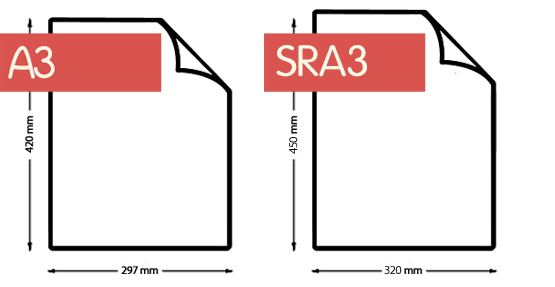
- Relatively few devices can handle formats larger than SRA3 (again, this may no longer be valid when you read it).
- Another limitation is the difficulty or lack of possibility to print on very high calipers of solid board.
Get in touch with us—together we will decide whether digital printing or offset is better for your project and choose the right technology for your run size and deadline.