



Screen Printing – Basics, Tools and Printing Process
What Is Screen Printing?
Screen printing is another well-known printing technique. It can be used on many substrates: paper, board, film, metal and even on ready-made, shaped objects. Moreover, the textile industry has helped to popularise this method more than any other sector. In addition, screen printing works extremely well for large, flat areas printed with dedicated screen inks.
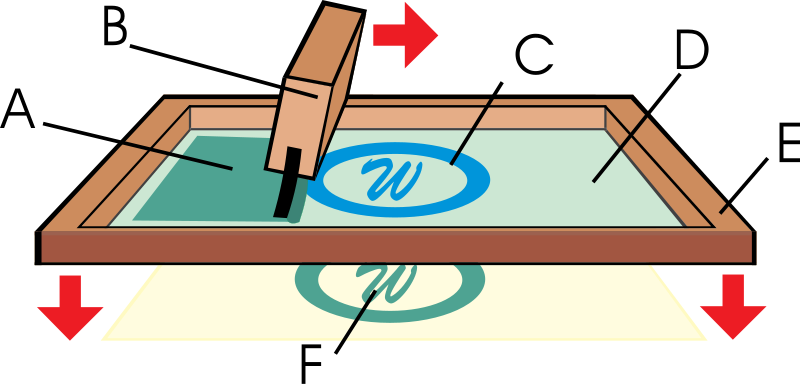
A – ink, B – squeegee, C – open mesh area, D – mesh area covered by the stencil, E – screen frame, F – printed impression
The Screen – Heart of the Process
As the name suggests, the key element is the screen. The process starts with an aluminium frame on which a special mesh is stretched. This mesh plays a decisive role. After the mesh openings have been blocked in the non-printing areas, a ready-to-use stencil is created. Then the ink is pressed through the open mesh openings onto the substrate. Furthermore, commonly used meshes usually have around 100 to 150 threads per cm², which ensures both detail and coverage.
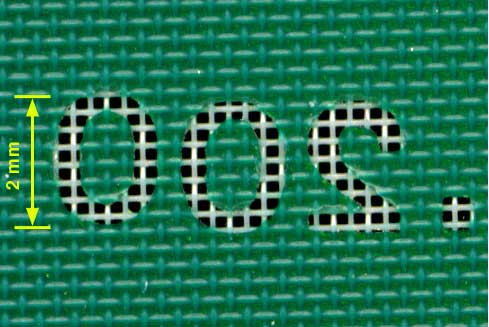
How Non-Printing Areas Are Covered
Blocking the parts that should not transfer ink can be carried out in several ways. Therefore, printers use different stencil-making techniques depending on the job and required durability of the screen.
- Manual application of a blocking solution onto the mesh, which forms an impermeable layer after drying.
- Drawing with ink or lithographic crayon directly on the mesh surface.
- Using cut paper or film stencils placed on the mesh.
- Coating the mesh with a light-sensitive emulsion that is dried and then exposed in a vacuum frame.
The Squeegee – Driving the Ink
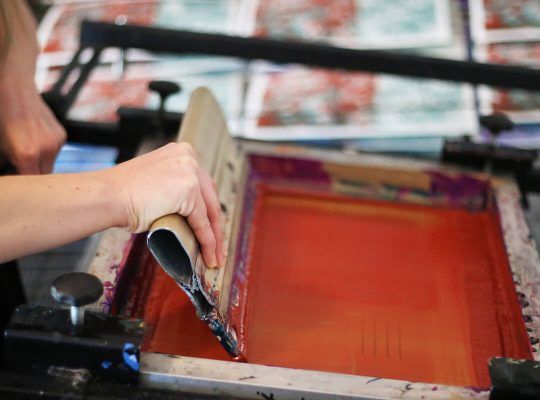
An essential tool in screen printing is the squeegee, used to push the ink through the mesh onto the substrate. Its size and hardness depend on the job. Typically, it consists of a plastic blade or elastic strip mounted in a handle. In everyday shop talk it is also called a wiper or doctor blade, because it literally wipes the ink across the screen.
Screen Printing Inks
In screen printing, two main ink types are used: water-based and plastisol inks. Water-based inks are free from PVC and formaldehyde, which is a major advantage. Moreover, they work well with very fine meshes and give strong colour saturation. Plastisol inks, on the other hand, are thicker, so they cover less absorbent or uneven substrates more effectively. In addition, they do not dry on the screen during printing, which keeps the process stable and efficient.
Besides these two groups, printers sometimes use solvent-based inks, UV-curable inks and dedicated screen printing adhesives for specialist applications. As a result, screen printing covers a very wide range of effects and substrates.
How the Printing Process Works
In its simplest form, the process consists in pushing ink through the mesh. The ink is placed on the screen surface and, after one stroke of the squeegee, it is forced through the open areas directly onto the substrate. However, with cylindrical objects the situation is different: the squeegee remains in position, while the screen moves and the object rotates under it. Furthermore, modern screen printing machines use servo drives that synchronise the speed of the screen and the product, which makes the whole process more precise and repeatable.
History of Screen Printing – From Japan to Modern Industry
Japanese Origins of Screen Printing
The history of screen printing has its roots in Japan. As early as the 17th century this technique was used to decorate kimonos. Moreover, Yuzensai Miyasaki and Zisukeo Hirose are regarded as pioneers of the method. The former used screen printing to decorate garments, while the latter developed a paper stencil known as “katagami”.
Just like today, the paper motif was placed on a mesh made from human or animal hair stretched on a wooden frame. In addition, on the Fiji Islands people used banana leaves to create stencils, which shows how inventive different cultures were when working with early screen printing.
Growth in the United States
With the beginning of World War I, screen printing started to develop rapidly in the United States. It is worth mentioning that John Pilsworth from San Francisco created a method for multicolour printing from a single form, therefore the process became much more efficient. Later another breakthrough came with Louis F. D’Autremont’s invention of the Profilm shellac film, which made stencil preparation easier and more repeatable.
Shortly afterwards Joseph Ulano introduced a celluloid film to the market. Importantly, this type of film is still used today, which shows how durable some of the early technical solutions turned out to be.
Europe, Serigraphy and the Polish Context
In the 20th century screen printing reached Europe and quickly gained recognition as a printing technique. Furthermore, serigraphy soon began to function as an artistic medium, finding its way into art schools and studios. In Poland, during the 1970s and 1980s, screen printing played an important role in underground printing houses, so it had historical significance that went beyond purely commercial applications.
Screen Printing Today and Industry Associations
Today, the Polish Screen and Digital Printing Association, based in Kraków, operates on the local market. Previously it was known as the Polish Screen Printers Association. The organisation promotes knowledge about screen printing and, in addition, regularly shares industry news with its members and partners. What is more, it belongs to the international organisation FESPA, therefore it links the Polish market with the wider global community.